

People living with HIV/AIDS continue to suffer a lot of stigma and discrimination in Uganda. But stigma and discrimination are not the same thing. This is why it is important to differentiate them.
menu trigger
menu trigger

Click to Submit your FeedbackHelp Us Serve U BetterCall us+256 776 237 512 | +256 700 541 667 | +256 751881 773Whatsapp no:+256 702 040 213

Background of the Eye Clinic at Kisubi Hospital
In 2014, when I first joined Kisubi Hospital, eye care services were provided through weekly visits by an optician from Mengo Hospital. Patients would line up eagerly, grateful for the opportunity to receive treatment at a highly subsidized fee. Despite this arrangement, demand remained overwhelming, with many patients continuing to seek help throughout the week.
There were occasions when the clinic could not be held because the visiting team was engaged in outreach programs in distant communities. On such days, we had the difficult task of explaining to disappointed patients why services were unavailable. This highlighted the urgent need for a permanent, in house solution.
Recognizing this, Hospital Management made a strategic decision: one of our clinicians would undergo specialized training in ophthalmology, with the long term vision of establishing a dedicated Eye Clinic within Kisubi Hospital. After years of preparation and commitment, that vision became reality in 2018.
In November 2024, the hospital proudly inaugurated a fully-fledged Eye Clinic, now housed in the new Special Clinics Department on the third level of the Outpatient Building. The facility is well equipped with modern diagnostic and treatment instruments, and staffed by an Optometrist, an Ophthalmic Clinical Officer alongside a resident Ophthalmologist.
Since its opening, the clinic has quickly become one of the busiest units in the hospital. It serves students from surrounding schools, senior citizens, and patients of all ages. Common symptoms with refractive errors, long and short sighted, near and distance vision defect, age related eye problems, glaucoma, cataracts, red eyes, diabetic retinopathy and Retinopathy of Prematurity screening and treatment.
To ensure comprehensive care, Thursdays are dedicated to planned surgical procedures in theatre, while emergency cases are attended to promptly whenever they arise.
Looking ahead, the establishment of the Eye Clinic marks a significant milestone in Kisubi Hospital’s journey of growth. Yet this is only the beginning. The hospital envisions expanding outreach programs to reach underserved communities, strengthening partnerships with schools to promote early detection, and investing in advanced surgical technologies.
With this forward looking vision, the Eye Clinic stands not only as a response to past challenges but as a beacon of hope committed to safeguarding sight, enhancing quality of life, and serving generations to come.
Donations have also always made a difference in the Eye clinic – extending the gift of Sight to many people in the communities. Through the generosity of partner organizations, Kisubi Hospital has been able to supply reading glasses to patients during our outreach programs. These donations are more than just lenses – they are instruments of dignity, independence, and hope.
Supporting the Vulnerable – For many individuals in underserved communities, the simple act of receiving a pair of reading glasses transforms daily life. Tasks such as reading, sewing, or caring for family members become possible again, restoring confidence and self reliance.
A Shared Mission – This collaboration reflects our collective commitment to inclusive healthcare. By joining hands with organizations that share our vision, we ensure that essential eye care reaches those who need it most.
Service with Love
Written by
Ruth Namutebi
Patient Care Coordinator
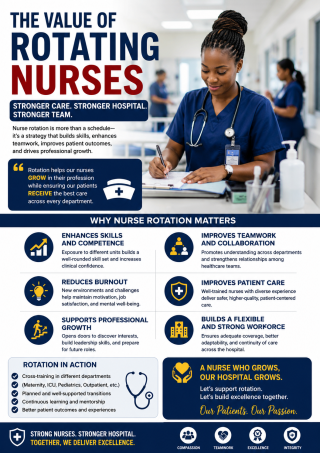
The Value of Rotating Nursing Staff
When you work in a department long enough, it becomes familiar almost like home. You grow attached to the environment, the routines, and the people. Because of that comfort, the idea of moving to another unit can feel unsettling or even unbearable.
Last week, while I was in the Physiotherapy Department, I met a Nursing Assistant who truly impressed me. She had previously worked in the Dental Section and the Radiology Department, and her confidence and competence in each of those areas were evident. She handled patients with such ease that no one questioned her credibility or skill.
Seeing her took me back to the days when we had only one Nursing Assistant covering each of those sections. Whenever she was absent, the entire workflow suffered. Looking at the situation now, I am grateful that the HR office recognized the need to rotate staff in this category. Through periodic movement from one section to another, our Nursing Assistants have become more versatile, better trained, and more knowledgeable in patient care across multiple specialties.
A few months ago, management made another bold decision: they transferred some Critical Care Nurses from the Heart Centre to the Emergency Unit. Many of us were unhappy about it at first. Change is never easy. But interestingly, we have recently been receiving several cardiac emergency cases. As the coordinator, whenever I call the Emergency Department and find that one of those cardiac‑trained nurses is on duty, I feel reassured. Their expertise gives me confidence that the patient will receive the specialized care they need.
In many ways, this experience has shown me that rotation is not just an administrative decision, it is a strategic investment. It strengthens departments, builds capacity, and ensures that when critical moments arise, the right skills are available where they are needed most.
Rotation, when done thoughtfully, is not a disruption. It is a powerful tool for growth, resilience, and improved patient care.
This also reminds me of a situation years ago in the Maternity Ward. At that time, we had one particular Nursing Assistant who was solely responsible for registering mothers. She was deeply attached to the mothers she served and performed her duties with exceptional dedication. When management eventually transferred her to the Outpatient Department, it felt like a drastic change. She had never worked in that environment before, had no experience with the patient flow, and was unfamiliar with the processes in that department.
But today, the transformation is remarkable. She has gained extensive knowledge and confidence, and she is now able to assist patients across all clinics in the Outpatient Department. Watching her grow into such a versatile and capable staff member is a powerful reminder of what rotation can achieve. It builds adaptability, broadens skills, and strengthens the entire healthcare system.
Written by
Ruth Namutebi
Patient Care Coordinator
A child’s mind is a blank slate that every passing person leaves a mark on. Everything a child becomes is a result of an idea, attitude or impression she or he takes in and accepts as true. To them, it becomes true regardless of what the fact might be
Heart attacks and Cardiac arrests are one of the most challenging issues medical personnel deal with. It is important for every medical facility to have basic knowledge about the occurrences of these health conditions and what to do soon as any is detected. Cardiac arrests and Heart attacks give medical personnel only a fraction of time to make split second decisions to save a life at stake.
By Angella Nandawula
Did you know that children often have changes in their behaviors when sick? Did you know that some may be able to tell you when not well but others will not and interestingly won’t have any sign of a disease?

Parenting a child’s mentality, why negative words could affect your child forever
A child’s mind is a blank slate that every passing person leaves a mark on. Everything a child becomes is a result of an idea, attitude or impression she or he takes in and accepts as true. To them, it becomes true regardless of what the fact might be.

HOSPITAL TALK: You don’t have to suffer because you can’t see objects near you
More than half of adults over the age of 40 have presbyopia with women having a higher prevalence yet the majority do not have corrective spectacles

HOSPITAL TALK: Why more people are dying in bathrooms in Uganda
Fainting during or shortly after urination it is a phenomenon which is medically termed as “micturition syncope/post micturition syncope”.

Kisubi Hospital Patient care in numbers
Successes and awards
The hospital actively pursues access to all services for the entire population, of its established area of responsibility, especially for the less privileged and vulnerable.
0123456789001234567890%
HEALING SUCCESS
Kisubi Hospital is a well advanced, modern and updated hospital committed to providing quality health care.
0123456789001234567890012345678900123456789001234567890012345678900123456789001234567890
PATIENTS SERVED
Our team is always available to give you a worm reception and professional care during your hospital.
0123456789001234567890+
CERTIFICATES & AWARDS
We have a number of awards both locally and international
012345678900123456789001234567890
YEARS OF EXPERIENCE
The Hospital has a bed capacity of 100.It is committed to a holistic, integrated and sustainable action in health.
ADDRESS
Kisubi, Katabi Entebbe
1.8km from Kawuku Trading Centre
24km Along Entebbe Road
CALL US
+256 776 237 512
+256 700 541 667
+256 751 881 773
WRITE TO US
customercare@kisubihospital.co.ug
kisubi@ucmb.co.ug
BOOK AN APPOINTMENT
Click here to book an
appointment at Medicare.

ADDRESS
Kisubi, Katabi Entebbe
1.8km from Kawuku Trading Centre
24km Along Entebbe Road
WRITE TO US
customercare@kisubihospital.co.ug
kisubi@ucmb.co.ug
CALL US
+256 776 237 512
+256 700 541 667
+256 751 881 773